Last updated 2026-11-12
Swivel vs Rigid Casters: What’s the Difference and How to Choose?
Compare swivel vs rigid casters, learn how 2 swivel + 2 rigid and four-swivel layouts affect steering, and choose the right setup for your trolley.

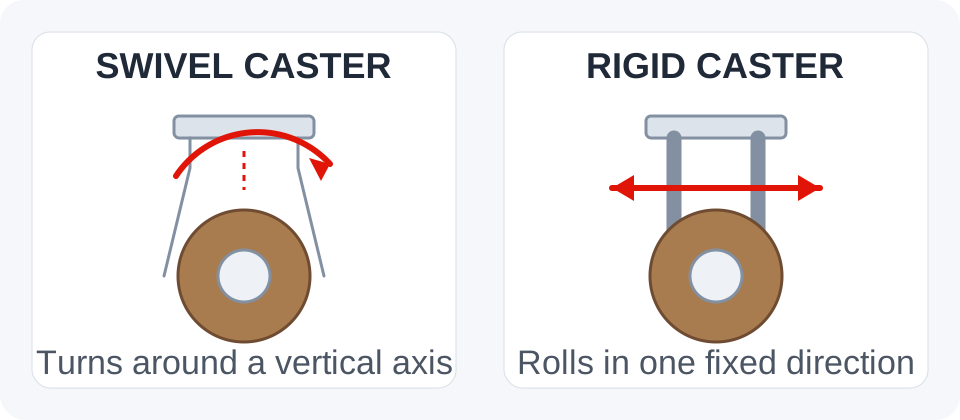
The main difference between swivel and rigid casters is steering: a swivel caster rotates around a vertical mounting axis, while a rigid caster holds the wheel in one fixed direction. The right choice is not simply the most mobile option. It is the layout that lets your equipment turn, track and stop predictably on its actual route.
Quick answer: swivel vs rigid casters
Use swivel casters where direction changes and tight positioning matter. Use rigid casters where straight-line tracking matters. For many manually pushed trolleys, a 2 swivel + 2 rigid caster arrangement balances those needs; four swivel casters favour manoeuvrability in confined spaces.
| Factor | Swivel caster | Rigid caster |
|---|---|---|
| Mounting movement | Rotates around a vertical axis | Fixed in one rolling direction |
| Steering | Changes direction and repositions easily | Does not steer the equipment by itself |
| Straight tracking | May need more operator correction | Helps maintain a straight path |
| Clearance | Needs room for the wheel and brake to sweep through a turn | Needs no swivel sweep, but still needs wheel and brake clearance |
| Typical role | Turning, positioning and confined-space handling | Longer straight runs and directional stability |
Neither type is automatically stronger. Check the exact model's rated load, wheel, bracket, bearings and test conditions rather than choosing by swivel action alone.
What is a swivel caster?
A swivel caster has a raceway between its mounting and fork. This lets the fork rotate so the wheel can follow a change in direction. The wheel is normally offset from the swivel axis, so it trails into line as the equipment moves. That offset also means the wheel and brake need clearance throughout the turn.
Swivel casters are useful on equipment that turns frequently, works around obstacles or must be positioned accurately. A swivel lock can temporarily hold the swivel action for straighter travel, while a wheel or total-lock brake addresses parking. These are different functions: a parking brake is not a substitute for directional control.
What is a rigid caster?
A rigid caster, also called a fixed caster, has a fork fixed to its mounting. Its wheel rolls forward and backward in one plane but does not rotate around a vertical mounting axis. A pair of correctly aligned rigid casters provides a directional reference that helps a trolley track straight.
Rigid casters suit equipment with repeated straight routes or a fixed travel path. Alignment is important: if the wheels are not parallel, they can scrub and increase push effort. Turning a four-corner rigid layout requires tyre scrub or another engineered pivot arrangement, so do not assume fixed casters are interchangeable with swivels.
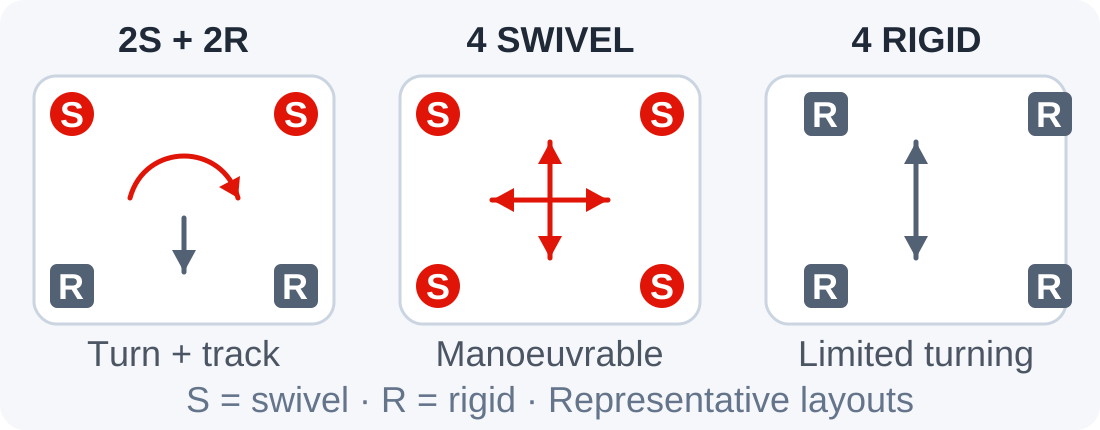
Common caster configurations for trolleys
The layout determines how individual casters work together. Start with the route, handle position, load centre and available turning space, then confirm the arrangement with a loaded sample where handling is critical.
Two swivel and two rigid casters
This common mixed layout combines steering with straight-line stability. The rigid pair resists unwanted lateral wandering, while the swivel pair allows the trolley to change direction. It is a practical starting point for platform trolleys, warehouse carts and equipment that travels straight before turning into a workstation.
There is no universal rule that the swivel pair must always sit at the handle end. Reversing the layout changes steering response and the operator's leverage. Define the pushing direction, check how the loaded trolley turns and reverses, and keep the rigid wheels parallel. Test the intended arrangement rather than copying a diagram blindly.
Four swivel casters
Four swivel casters allow a trolley to turn and reposition in tight aisles, crowded work areas and around equipment. They are useful when the operator needs freedom of movement in several directions. The trade-off is less inherent straight-line guidance, particularly on longer routes or with a high or off-centre load.
If the same trolley also makes longer straight runs, consider swivel locks on suitable positions. Brakes can hold the equipment during loading, but they do not make an all-swivel moving trolley track like a mixed layout.
Four rigid casters
Four rigid casters in a conventional rectangular corner layout favour fixed forward-and-backward movement. They restrict normal steering because every wheel remains aligned; forcing a turn can scrub the tread and increase operator effort. This arrangement is therefore limited to routes and frames designed around that behaviour.
Specialist diamond arrangements use a different geometry, often with a central pivot pair, and should not be confused with four equal-height rigid casters at the corners. Ask for an engineering review when pivoting a loaded platform is part of the requirement.
Which setup fits your application?
- Warehouse and logistics trolleys: start with two swivel and two rigid casters for mixed straight routes and turns. Review four swivels when confined-space positioning is more frequent.
- Medical and service carts: swivel casters support precise positioning; add the required parking brakes and consider directional control for corridors. Keep noise, cleaning and floor protection in the specification.
- Workbenches and factory equipment: choose the layout around how often the unit moves and where the operator stands. Parking stability and full swivel clearance can be as important as steering.
- Furniture and displays: swivels help with repositioning, but small frames still need clearance for the offset wheel and brake. Confirm the mounting before changing the layout.
See the JLS application guide for environment-specific options. For any layout, calculate capacity with the caster load guide, compare tread and floor requirements in the seven-step selection guide, and verify the connection with the mounting guide.
Common selection mistakes
- Assuming four swivel casters are always easier to control on every route.
- Choosing rigid casters for a rectangular trolley that must turn through narrow spaces.
- Copying a swivel-end placement without testing the loaded equipment and pushing direction.
- Assuming rigid casters have a higher load rating than comparable swivel models.
- Forgetting swivel sweep, brake access and clearance around the frame.
- Mixing different diameters or overall heights without reviewing load distribution and equipment level.
Buyer checklist before requesting a quote
Record the equipment and payload weight, caster count, preferred layout, handle position, route and turning space, floor condition, wheel diameter, mounting dimensions, overall height and brake requirements. Note whether the trolley is manually pushed or powered; manual-push guidance should not be applied to towing without a separate review.
Browse the JLS caster catalogue for mounting and tread options, or send your layout and operating details. A simple top-view sketch with the handle and swivel positions marked helps narrow the suitable models and drawings.
Frequently asked questions
Can you use four swivel casters on a trolley?
Yes. Four swivel casters are useful when a trolley must turn and reposition in tight spaces. They provide less inherent straight-line guidance than a mixed layout, so review the route, load and operator control. Directional locks can help on longer straight runs.
Where should swivel casters be placed?
There is no universal best end for every trolley. In a two-swivel, two-rigid layout, placement affects steering response, tracking and operator leverage. Mark the handle and travel direction, keep the rigid pair aligned, and test the intended layout under its working load.
Are swivel casters better than rigid casters?
Neither is universally better. Swivel casters favour turning and positioning, while rigid casters favour straight-line tracking. Many trolleys use both to balance manoeuvrability and directional stability.
Do rigid casters have a higher load capacity?
Not inherently. Load capacity depends on the complete model, including its wheel, bracket, bearings and stated test conditions. Compare the rated load of the exact swivel and rigid SKUs rather than assuming that a fixed fork carries more.

Zehong Dong — Technical sales manager, JIELISHI
Handles OEM and distribution enquiries for casters — load and mounting selection, sample approval, custom tooling and the production follow-up in between.